
Real vs Fake Dumpling Squishy: The Five-Second Squeeze Test
DumpliPop · August 30, 2026 · 3 min read
There is one test, it takes five seconds, and it does not require you to have ever held a real one. Squeeze the squishy completely flat, let go, and count. A genuine slow-rise dumpling takes roughly two to five seconds to rebuild its shape. A fake is back instantly, or never gets there.
Every other check on this page is a way of guessing the answer to that one before your money leaves your hand.
Why the counterfeits exist
Slow-rise foam is the expensive part of the toy and the only part a photograph cannot show. A copy moulded in ordinary sponge looks pixel-identical in a listing, costs a fraction to make, and fails the moment it is squeezed. That asymmetry is the whole counterfeit business — everything else about the product is trivially cloneable, including the photos, which are usually lifted from the real seller.
Before you buy: five things visible in a listing
- No measurement. A genuine listing states a size in centimetres. "Large" and "jumbo" are not sizes, and a photo on a white background communicates nothing about scale.
- No material named. Real ones say TPR. A listing that says only "soft foam" is avoiding the question.
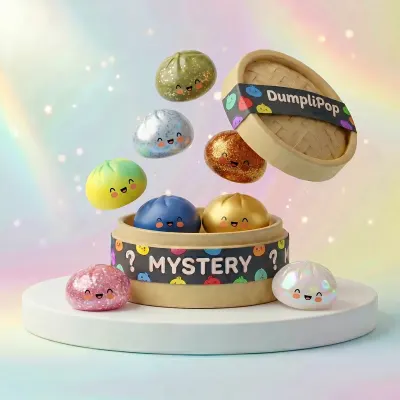
- No steamer, or a steamer only in one photo. Genuine dumpling squishies ship in a miniature bamboo steamer. Copies skip it, or show a stock image of one they do not include.
- A price far below the band. Full-size singles sit around $20 to $30. A few dollars for a full-size single means the foam has been substituted; there is no other place that saving can come from.
- Photos that appear across many sellers. Reverse-search one image. If the same shot is running under six different shop names, none of them made the product.
After it arrives: the physical tells
In order of how conclusive they are.
- The rise. Two to five seconds, scaling with size — a mini is quicker than a giant because there is less foam to move. Instant snap-back is the disqualifier.
- The crease. Squeeze hard and release. A genuine one comes back smooth. A fake keeps the fold.
- The smell. Real TPR is close to odourless out of the box. A strong chemical or rubber smell that persists after a few days points at low-grade material.
- The surface. It should be dry and slightly powdery, not tacky. Stickiness means plasticiser is migrating out, and that squishy has a short life.
- The steamer. A real one is a fitted object the squishy sits in. A fake's is thin, loose, or already split at a corner.
- The color. Pigment through genuine foam is even. Copies pool color to one side or come out muddy, because the material was mixed rather than cast.
Where fakes concentrate
Not evenly. They cluster in third-party marketplace listings with no named brand, on social storefronts that appeared in the last few weeks, and anywhere the seller's whole catalogue is stock photography with no measurements. They are rare on a brand's own site, for the obvious reason that a brand selling its own product has nothing to substitute.
What to do if you got one
Photograph the squeeze test. A short clip of a toy failing to rise is the clearest possible evidence, far stronger than a still photo, and every marketplace's counterfeit process accepts it. Open the dispute on the platform rather than emailing the seller — a seller shipping fakes will run out the clock on the return window.
The honest caveat
A genuine slow-rise squishy that has been left in a hot car or on a sunny windowsill will also fail the squeeze test. Heat is what kills the foam, and it kills a real one as thoroughly as a fake was born dead. If a squishy arrives working and stops rising months later, that is storage, not counterfeiting — keep them out of direct sun.
Shop what this guide covers
Keep reading
What Are Dumpling Squishies Made Of? Materials, Safety and Slow Rise Explained
A dumpling squishy is made of slow-rise TPR foam, with PP and PU in the mix, and it is that foam alone that decides whether the toy is any good. Everything…
Aug 30, 2026 · 3 min read
What Is a Dumpling Squishy? Sizes, Foam and What You Actually Get
A dumpling squishy is a slow-rise foam toy moulded in the shape of a bao. You squeeze it flat, let go, and it takes a few seconds to puff back out. That…
Aug 30, 2026 · 4 min readWhere to Buy a Dumpling Squishy: Marketplace, Reseller or Direct
Dumpling squishies are sold through four kinds of channel, and they fail in four different ways. Knowing which one you are in tells you what to check before…
Aug 30, 2026 · 4 min read